How HBOT Actively Disrupts the Inflammatory Loop
Hours after carbon monoxide poisoning, your brain is still in extreme danger. Discover how HBOT acts as a high-pressure intervention to halt the hidden inflammatory loop. Beyond clearing CO from the blood, Hyperbaric Oxygen Therapy actively disrupts the molecular wildfire in the brain. Learn the 4 ways HBOT shuts down NF-κB and inflammation.
By Attorney Gordon S. Johnson, Jr.
You’re rushed to the emergency room for carbon monoxide poisoning. The medical staff, may or may not rush you into treatment. If you’re fortunate enough to be near a specialized medical center, you might get a chance to go to a steel chamber, a hyperbaric oxygen chamber. The probabilities though are that even in a place like Philadelphia, only about one out of 20 people who survive carbon monoxide poisoning do get referred to the chamber, the HBOT chamber, for HyperBaric Oxygen Therapy.
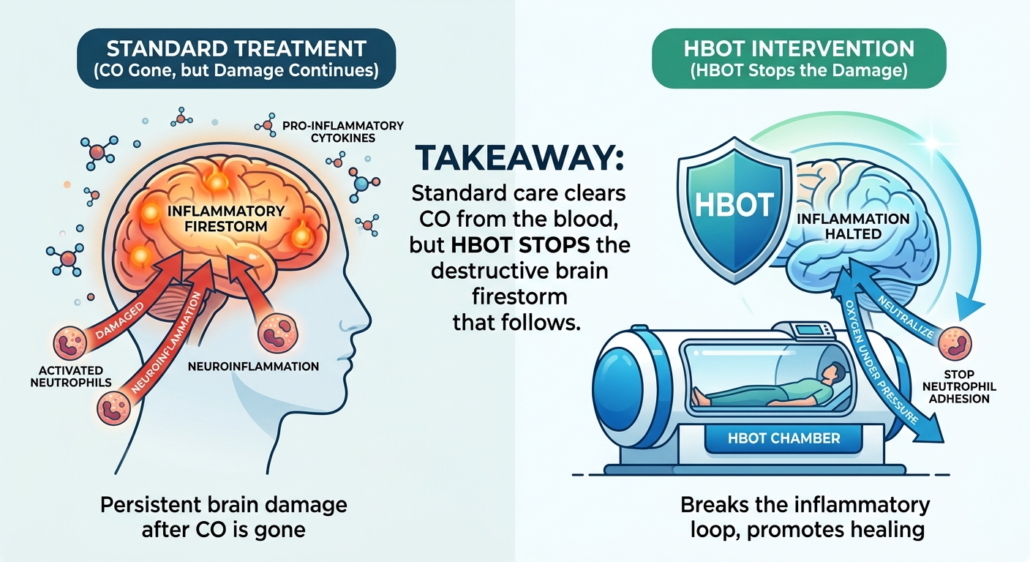
After carbon monoxide poisoning, there is still extreme danger of brain damage from the inflammation that CO sets off. HBOT is a high-pressure intervention to halt the hidden inflammatory loop.
The theory of too many, even too many ER docs, is that this HBOT treatment is to restore oxygen levels and drive the CO out of the patient’s blood. If that was its only purpose, then once the COHb is out of the blood, there is no longer a purpose for HBOT. By the time the typical CO survivor gets to the chamber, hours have passed. Blood tests are probably showing that COHb levels are already dropping back to normal.
What doctors and scientists and even lawyers who study CO know, is that regardless of the restored Oxygen levels, the brain is still in extreme danger. See our last blog for the NF-κB off switch. The toxic gas may be gone, but the molecular wildfire is off and running. Hyperbaric oxygen is not a breathing aid. It is a high pressure intervention put a stop to the inflammation and the immunological broken cellular code. Hyperbaric oxygen therapy is a way to inhibit the nfkb from violently slamming the runaway inflammatory switch.
The physics of hyperoxia flooding the liquid blood.
First we must ask, after that chart in our last blog, that is almost incomprehensible. Why should you the CO survivor care about the why? You need to know one thing. HBOT gives me the best chance for a full or satisfactory recovery. What is the difference? A full recovery means there is no brain damage. A satisfactory recovery means that the survivor has adapted to the damaged brain in a way that didn’t result in disability. So why all this complicated chemistry? Because doctors need to understand this stuff and you may or your loved one, reading this while they wait, may need to be the advocate to the ER doctor, who sees 5-10 a year, and learned somewhere they can’t remember, that only people whose COHb levels are above 20% need HBOT.
So that as the why we care, let’s talk about why HBOT works. Under normal circumstances, you breathe about 21% oxygen. Your red blood cells carry oxygen to the cells, like tiny pneumatic robots. Those robot carriers have a cargo limit. Once those robots are at capacity, breathing more oxygen in normal atmosphere does not change the carriers capacity to deliver blood. Inside the chamber, you are breathing pressurized oxygen. To stay with our delivery robots, we have used pressure to squeeze more oxygen along for the ride. This extreme pressure bypasses the red blood cells entirely physically forces oxygen directly into the liquid plasma of the blood. This creates a massive what they call Hyperoxic pulse. Hyperoxic pulse? Think of flooding injured starved brain tissues with levels up to ten times higher than normal.
This oxygen surge triggers a defensive and healing chain reaction. The four biochemical interventions from hyperbaric oxygen therapy.
HBOT as the Molecular Off Switch after CO
Once the wave of high pressure oxygen reaches the brain. It acts as a molecular off switch, dismantling the inflammatory loop through four different ways. Antioxidant
Flipping the antioxidant master switch. As we talked about in our last post. CO poisoning chokes the mitochondria. The result, toxic free radicals. That’s a mouthful. Toxic free radicals . This sudden spike in toxic free radicals tricks the cell into activating its genetic defense mechanism. The NRF2 pathway. Who the hell knows what that is, almost certainly not the ER doctor. Whatever it is, HBOT can act as an anti-inflammatory mirror to nuclear NF kB.
Once flipped on, NRF2 floods the cell with natural potent enzymes, which rapidly neutralize the toxic free radicals. Neutralize the free radicals and you remove the primary fuel that is keeping the DNS cascade going.
Stopping the Malicious Cells from Escaping.
HBOT can become like a cop on the beat, jailing the rogue proteins. In a CO poisoning, rogue enzymes called IKK act like wire cutters, chopping up the IκB inhibitor proteins that are supposed to keep inflammatory factors trapped. The HBOT flood of oxygen, directly blocks these IKK wire cutters. By shutting them down, the cell is finally able to rebuild and stabilize its IκB inhibitor proteins. These newly minted “handcuffs” bind straight to the rogue molecules. The cellular cops drag these bad actors out of the cell’s nucleus and locking them back into a harmless, inert state.
Paralyzing White Blood Cell Adhesion (The Vascular Brake)
CO poisoning causes a structural quagmire in the brain’s blood vessels. CO makes passing white blood cells (neutrophils) manufacture sticky surface proteins called beta-2 integrins. These cells stick to the blood vessels like wet leaves on a windshield. Beta-2 integrins clog circulation and leak neurotoxins that trigger localized immune activation across the blood-brain barrier.
Remarkably, when HBOT can paralyze these sticky proteins on the surface of white blood cells. Unable to stick, Beta-2 integrins slide harmlessly through the brain’s microvasculature. This can halt the immune flare-up.
Rescuing the Stalled Mitochondria
Finally, the extreme pressure it physically shoves remaining CO molecules off the cell’s mitochondrial proteins. Once the mitochondrial proteins can breathe again, they stop sending out calling for help.
Some of these mechanisms, but not all, work best if the treatment is administered while the COHb is still in the blood. But once this cycle gets going, HBOT can still be effective in limiting its damage. HBOT is the best early treatment we have for CO poisoning and if you or your loved one is being treated for it, demand you get it. I would cite you sources, but the ER is no place for a detailed lecture in Microparticles. If you want to learn more, search the name Stephen Thom on PubMed. He and his team are adding new science to this equation every year. The undisputed part – HBOT stops inflammation and that is the biggest culprit.
Leave a Reply
Want to join the discussion?Feel free to contribute!