Portable Electric Generators – Choosing Public Safety VS Industry Regulation
Portable electric generators are one of the most dangerous products the CPSC is tasked with regulating but efforts to make them safer can’t get approved.
By Rebecca Martin
Portable Generators are one of the most dangerous consumer products on the market
“Allen County residents are freezing in their homes with absolutely zero chance of getting water or power in the next week! People are going to die out here, water towers are empty, water lines are broken, lines are down that will stay down. The roads are all pure black ice.”
Electric Generators are Multipliers to Destructiveness of Storms
This is a public cry for help posted on social media this week in Kentucky, where National Guardsmen have been deployed as part of a state of emergency due to frigid temperatures and a winter weather front that left a major portion of the country icebound.
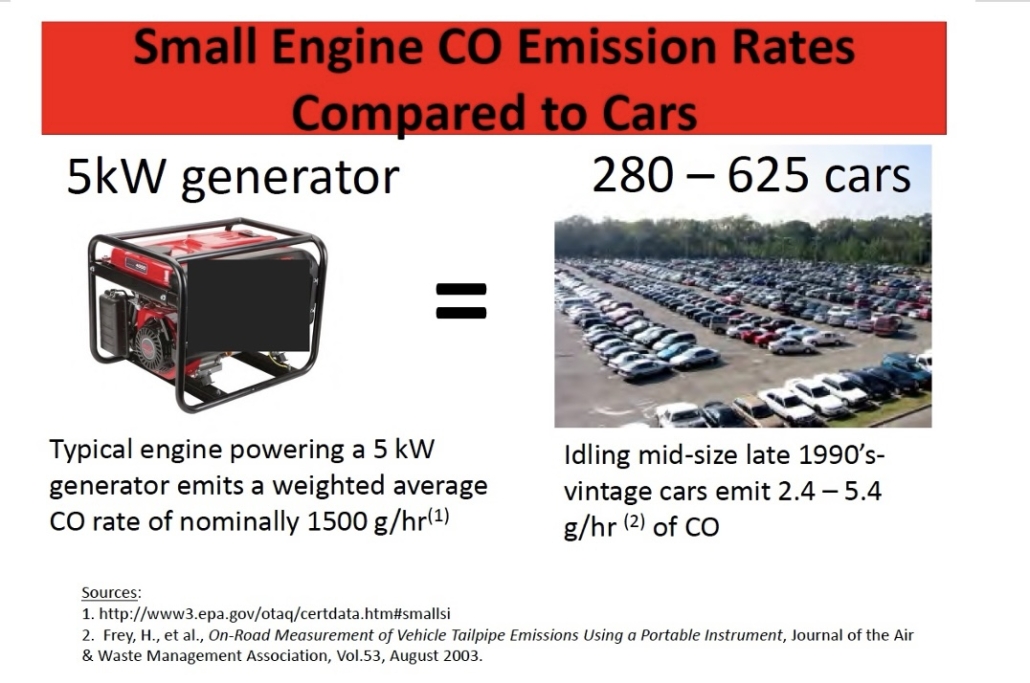
Portable Electric Generators are far more deadly than automobile emissions but the CPSC, despite a generation of efforts to make them safer, has failed to implement safety rules which would save lives and disability.
On Tuesday, January 27, Nashville, Tennessee news reported that almost 50 had been treated at the Nashville Children’s hospital for carbon monoxide exposure during the winter storm. Most were admitted for treatment which consists of 24-48 hours of oxygen therapy. One suspected carbon monoxide related death is still under investigation in Tennessee.
Portable Electric Generators Deaths Keep Making News
Injuries from carbon monoxide poisonings are not all the news. On January 26, an 86-year-old man died, along with his pet in DeSoto Parish, Louisiana, due to running a generator in his garage. A couple in Fulton County, Indiana, died on January 29, due to caron monoxide caused by HVAC issues and unvented equipment.
Changing weather systems have increasingly produced weather conditions that are life-threatening.
It is these life-threatening conditions that are sending consumers to the market for portable generators in record numbers. As the demand for portable generators grows so does the potential for injury or death due to carbon monoxide poisoning. While a push has been made to inform consumers of the dangers of portable generators, the industry itself has avoided accountability due to policies which enable the industry to self-regulate. And this self-regulation is at odds with the need for public safety.
CPSC has Tried to Regulate since Early 2000’s
For decades, the problem with portable generators has been common knowledge at the federal government level. Attempts to impose regulations which would force manufacturers to address safety issues in the design of portable generators have been stuck in a catch 22 of policies which allow the manufacturers to review their own shortcomings. And these reviews have continually been intentionally delayed and tabled by an industry unwilling to change. Ultimately that self-regulation has resulted in feeble attempts to place accountability on the public and resulted in an industry which hides behind the words “if used properly” or “read the warning label”.
According to the most recent Consumer Product Safety Commission (CPSC) report, approximately 100 people die annually due to carbon monoxide exposure from portable generators. Thousands end up in the emergency room or hospital, where statistically they receive little follow up to assess for permanent damage.
The Consumer Product Safety Commission (CPSC) has had to take on the issue of public safety vs industry guidelines, calling for changes which would make portable generators safer, similar to the introduction of catalytic converters in the auto manufacturing industry.
Instead, the generator manufacturing industry countered with a cheaper option in 2018, offering up a plan to install carbon monoxide sensors which would trigger cut-off switches to shut off engines if carbon monoxide reached a dangerous level in an enclosed space. But this cheap fix did not fix the problem because deaths still occur when unpredictable air flow conditions allow for accumulation of toxic buildup outside of the generator’s location. The recommendation is to place your generator 25 feet from your home, The only solution to the problem is to rethink generators with the goal of reducing emissions.
Exacerbating this problem is the fact that safety has been left in the hands of the CPSC which has had its hands tied by the industry’s self-regulation status. What has been accomplished was due to tremendous effort to hold an industry accountable. However, under the Trump administration, the entire agency is in the process of being phased out and absorbed by the Department of Health and Human Services. CPSC heads have been removed and the budget for consumer services has been decreased by 10 percent.
In addition, new policies focus on emphasizing industry-led voluntary safety standards over mandatory federal regulation. And while recalls are promised, the President has cited an increased focus on imported goods from the Republic of China due to ongoing trade wars rather than focusing on public safety issues at home. https://www.cpsc.gov/Newsroom/News-Releases/2026/President-Trumps-CPSC-Highlights-Key-2025-Safety-Accomplishments
In fact, safety regulations have been pulled back on everything from aerosol dusters to off-road vehicles to table saws. A clear sign that the generator industry will continue to remain self-regulating.
This leaves safety in the hands of the public. In the face of industry inaction, that takes us to a quick look at carbon monoxide poisoning detection. Defense rather than solution.
CPSC Funding for Carbon Monoxide Alarms
In 2022, a bipartisan bill was passed. The Nicholas and Zachary Burt Memorial Carbon Monoxide Poisoning Prevention Act, sponsored by U.S. Senators Amy Klobuchar (D-MN) and John Hoeven (R-ND). The bill created a grant program to fund initiatives to educate and raise awareness for the need for carbon monoxide detectors. The official mission statement is as follows: Promote the installation of carbon monoxide alarms in order to promote the health and safety of citizens throughout the United States.
According to the First Responders Grant page, in 2023, two million dollars was available through the CPSC “to provide eligible state, local and tribal governments with grants to purchase and install carbon monoxide (CO) alarms in residential homes and dwelling units of low-income families or elderly people and facilities that serve children or the elderly, including childcare centers, public schools and senior centers, and to develop training and public education programs with the goal of preventing CO poisoning.
The Carbon Monoxide Poisoning Prevention Grant Program (COPPGP) funds could be used for the procurement, distribution, and installation of carbon monoxide detection equipment. Award amounts were set at between $50,000 and $400,000 with a grace period of two years set to apply awarded funds.
During the fiscal years of 2023, 2024 and 2025, an annual amount of two million was available through this grant program, which is expected to continue in 2026 although the budget has yet to be determined. This information is available at the System for Award Management, sam.gov, which is a free government website where business can bid on federal contracts or entities can apply for grants. This is a consolidated portal that replaces several former portals.
It would seem then, that there is assistance available for many state entities when it comes to carbon monoxide detection and public education and awareness of carbon monoxide dangers. However, as we have noted many times, state regulations vary immensely and tend to focus on new construction without addressing existing structures. As we saw just recently, Governor Andy Beshear of Kentucky introduced an initiative to address carbon monoxide dangers in older schools and senior centers, something that seems almost incomprehensible that it was not already state law. Many states do not require CO detectors in high-risk venues like hotels and motels, for example. These are places human beings sleep, yet they are not protected while in their most vulnerable state.
The CPSC maintains that the focus is on preventing carbon monoxide poisoning through public education, grant programs and advocating for stricter product standards. But in a pro-deregulation administration, the focus is increasingly on public awareness and liability, and less on solutions like auto-shutoff features for generators or ultimately reducing the emissions responsible for the deaths and injuries which have occurred.
Will the CPSC Survive as We Know it?
The CPSC continues, presently, to operate as an independent federal regulatory agency despite the current administration’s firing of commissioners and a proposal that they move their function to the Department of Health and Human Services (HHS). This move is currently highly contested by consumer groups. It would result in reduced budget and staff. And it would be exposed to greater political and corporate influence. And the question has not been resolved as to the legality of the firings of the top commissioners in the agency. Though recalls and safety warning are at record highs, the question arises as whether recalls on incoming imports are overriding consumer problems domestically. And realistically, at what point do recalls become politically motivated.
It is in this current atmosphere of climate change denial and mean-spirited pokes at climate change during a catastrophic storm that we must consider the question of public safety and what those words mean. With an administration focused on deregulation of domestic industry and power over competing products entering the domestic market through import, the consumer appears to be losing power. We lose the choice to demand regulation for our safety. And we lose the choice to buy elsewhere. Then there is the question of acceptable loss.
What is acceptable when it comes to human lives? Is it fair to shift the blame to the consumer? If you read directions, follow safety rules and take proper measures, are you safe? But that is the wrong question. Are the standards for consumer proficiency too high? That is the standard we should be looking at. It disregards common sense, human behavior and most troubling, it is a standard based on unreasonable expectations.
Portable Electric Generators Must Be Used Properly
And this is why. The consumer buys a portable generator. He sits it in his garage and checks that off his disaster preparedness list. When is he going to read the manual? Is he going to take it out and peruse it over afternoon tea? No, he is most likely, like all of us, to be out in his garage in the middle of a power outage with his flashlight googling ‘how to start my generator’. Imagine he is 86 and knows that a generator must be placed 25 feet from his home. But he is not very mobile and its slippery and he doesn’t want to break a hip. He must choose between a bad decision (dying of hypothermia) and a worse decision (ignoring safety rules). People are people. And in emergencies people do stupid things because they are desperate.
And here’s the part that is bothersome. Even if you know to place a generator 25 feet from your home, realistically how many people have 25 feet of distance on their property to place a generator safely? In my neighborhood, I couldn’t point out a single home with that much space that wouldn’t infringe on a neighbor’s property and be too close to their home, endangering them. I may not have one, but my neighbor might.
Is it really the consumer’s responsibility when a piece of equipment is promoted for disaster preparedness, but they may not be prepared to use it safely, regardless of public education and awareness, safety warnings, users’ manuals and all other instructions. Wouldn’t it be safer to reduce or eliminate emissions?
If the answer is that it would require an expense an industry is not willing to take on, was that really the intent of allowing an industry to be self-regulating? I don’t think that was the intent. That was the condition: We will allow you to address this issue internally at the pace and in the direction, you wish to choose, but in no way does that imply that we intended for this to mean that self-regulation meant no regulation. We were under the assumption that public safety would be a big portion of the bottom-line and that advances in the industry would produce the best and safest options. Now that expectations have not been met and the industry has not made progress toward the goal, we should rethink that arrangement. And we have seen, with our own eyes, how deregulation has seldom, if ever, encouraged industry to consider the public good over profit.
In the end, the consumer is labeled as the responsible party, expected to take money, time and effort to save corporate entities from taking money, time and effort. But there is a big difference between the two because the cost of failure is a loss of life for the consumer.
Editor’s Comment (Attorney Gordon Johnson):
I testified, along with dozens of other industry experts in 2017, on the most comprehensive plan for generator safety in front of the CPSC. See Public Hearing Portable Generators …Regulations.govhttps://downloads.regulations.gov › content
This proposed rule was the result of 15 years of efforts from the CPSC to make generators safe. It was killed during the first Trump administration. During the Biden administration a much watered down version of the 2017 era rule was again set for hearings, but that rule making didn’t make it to the end of the process before the second Trump administration tabled it. See https://carbonmonoxide.com/2023/06/portable-generator-safety-new-cpsc-rule.html
Leave a Reply
Want to join the discussion?Feel free to contribute!