
East Louisville Carbon Monoxide Death
Smoke alarms don’t warn of carbon monoxide poisoning, which should have you calling on the seniors in your life to be sure they have CO alarms.
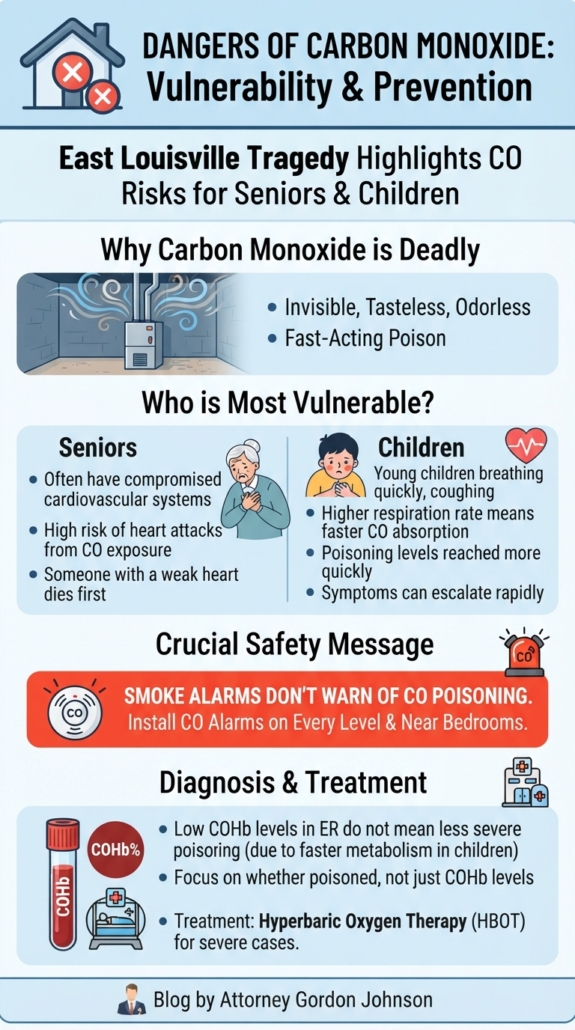
Smoke alarms don’t warn of carbon monoxide poisoning. Check your alarms to be sure what they do and make sure the seniors in your life have carbon monoxide alarms as they need them the most.
Last week it was five children, plus adults, in Fond du Lac, Wisconsin. This week it is an elderly couple in east Louisville, Kentucky. The man died, the woman was hospitalized. Carbon monoxide does not care about age but both children and the elderly are particularly vulnerable to its poison. For the elderly, the mechanism is predictable. Most of those who die of CO do so from heart attacks. The elderly often have compromised cardiovascular systems. So someone with a weak heart is likely to die first.
This likely explains why one person lives breathing the same air as a person who died.
For example, see the footnote below with the testimony in a defense expert’s own words.
Children are Harder to Diagnose
In children things are more complicated and made more so by poor understanding of how to measure the severity of CO in the blood. How fast CO gets into the blood system is largely a function of respiration rate. Children, especially small children, breath faster than adults. So carbon monoxide exposure in children will reach poisoning levels faster.
Likewise, carbon monoxide metabolism rates (the rate at how fast CO leaves the blood) is also largely tied to respiration. If children are breathing faster, their COHb levels will drop faster than adults. A lower COHb level when measured in an ER does not mean that the poisoning while in the environment wasn’t more severe than the adults was.
Every Survivor of CO Should Get All the Treatment
The COHb levels are important for us as lawyers. If we have an elevated COHb level, we can later prove that these particular individuals were poisoned. But from a medical standpoint, how high should never be the focus. The diagnostic question in a stable patient should be simply a question of whether the patient was poisoned or not. If they were poisoned, then they need all of the tools we have available, including Hyperbaric Oxygen Therapy. Why would someone with a 5% COHb level need HBOT? Because the carbon monoxide is a trigger to the immunological crisis that is often called DNS. Click here for more.
Back to the Louisville incident. There is one line from the news report that should stop every home owner. Even though the house had detectors, no alarms were sounding. If there was 500 ppm to 1,000 ppm of CO in the house, the alarms should have been going nuts.
Your smoke detector does not detect carbon monoxide
We who do this every day lose track of how little everyone else thinks about CO. A detector is a detector and almost everyone has lots of experience with smoke detectors. Most of us also have strategies as to how to get them to stop blaring (as detectors are supposed to make such an annoying sound you have to make them stop.) We smell smoke, we see the smoke coming off of our stove. We turn off the stove, we open the windows and we wave something in front of the detector until it stops blaring.
Carbon monoxide is invisible. You can’t see where it is coming from. Carbon monoxide is odorless (below very high levels). You can’t smell anything. So, if an alarm is blaring but you can’t figure out why. The default is there must be something wrong with the alarm. It must need new batteries. All which can be deadly mistakes. I won’t rehash all of this here.
Another major problem in this entire area is that carbon monoxide alarms look too much like smoke alarms. You look on the ceiling, know that there should be CO alarms and assume what you see on the ceiling is one. Manufacturers of alarms have for too long done inadequate jobs of differentiating the smoke alarm from the carbon monoxide detector from the combination alarm. It may say on the outside of the alarm but that isn’t labeled in contrasting letters, but molded into the plastic. Alarms are posted on the ceiling and if they are labeled, you may not be able to read the labeling from eye level.
Suggestion, take a picture with your cell phone and closely examine the picture. Lesson’s learned from doing this all the time.
The other problem is smoke detectors continue to function far longer than CO detectors. Historically CO detectors were only good for five to seven years ago. Your CO detector that was installed when they were first required, in most places about 15 years ago, is no longer fully functioning, if at all.
Simple fix: go buy a new one and our recommendation is get a ten-year sealed battery combination alarm. You don’t have to deal with replacing batteries, it will have you covered for both smoke and CO and you don’t have to think about it each year. For ten years. Such alarms should also have an end of life sensor. Don’t ignore that of course.
Why this week, and why I keep saying it
Last week with the Fond du Lac Wisconsin story, I wrote that the first cold days of the fall are the second-deadliest window for carbon monoxide. A week later it happens in Louisville. These two incidents, 500 miles apart, both at the first real cold snap, are not a coincidence. They are the season. If I wrote for CNN or a major network, maybe last week’s warning could have been heard in Louisville.
Do this even if it warmer today than it was last week:
Go look at the alarm on your ceiling. Like I said, take a picture with your cell phone. If it doesn’t have clear letters, then replace it. If it isn’t a CO alarm, then replace it.
And if there is an older parent or grandparent living alone or as a couple, make the same check in their home
Carbon monoxide poisoning is the only thing our firm handles. If someone in your family has been poisoned, or if you lost someone and the circumstances make you wonder whether carbon monoxide was ever ruled out, that is what we do, and we have done it well for decades. We have recovered more than $150 million for those who survived carbon monoxide poisoning.
Call 800-992-9447 if you want to discuss your case.
Footnote
The following is sworn deposition testimony from a physician with thirty years in hyperbaric medicine, retained by the defense to minimize the injury in one of our cases. Even testifying for the other side, here is what he said about who dies from carbon monoxide:
Q: You’ve seen people die who had levels in the 50s, correct?
A. Yes, correct.
Q: And that may very well be people who were older, who had some cardiac disease before they got poisoned, correct?
A. That’s correct. That raises the risk.
The patients that do poorly with carbon monoxide exposures that potentially result in fatality and death are usually those patients with underlying coronary artery disease… I don’t think I’ve ever seen a patient in my practice that had pure conduction abnormalities related to carbon monoxide that didn’t have underlying cardiac compromise from atherosclerosis or other forms of disease of the arteries of the heart that were causing that patient to do poorly from the CO. It’s usually a cardiac ischemic event related to atherosclerosis.
That is the defense’s own expert confirming the point: the people most likely to die of carbon monoxide are older adults whose hearts were already compromised. A level that a healthy person survives can kill someone with coronary disease — which is exactly why an elderly victim, and exactly why the death gets written off as a heart attack.
Leave a Reply
Want to join the discussion?Feel free to contribute!