Fond du Lac Carbon Monoxide Poisoning Results in Seven Hospitalizations
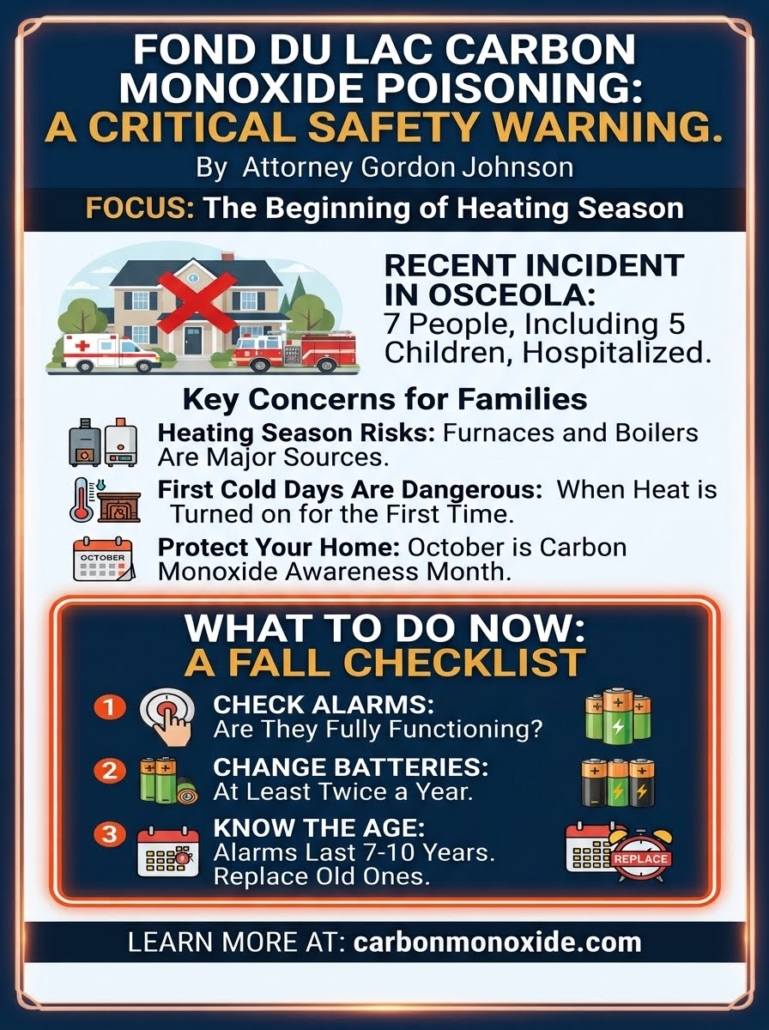
September’s last day results in a Fond du Lac County carbon monoxide poisoning that left seven hospitalized as the Midwest heating season gets off to a morbid beginning.
Authorities were alerted to a significant Fond du Lac County carbon monoxide poisoning in Osceola in Fond du Lac, Wisconsin today, when seven people were treated for carbon monoxide poisoning. See https://www.wearegreenbay.com/news/local-news/six-children-hospitalized-after-carbon-monoxide-incident-in-fond-du-lac-county/ Five children were included in those hospitalized.
Fond du Lac County carbon monoxide poisoning is an important reminder of the steps all Midwesterners must take as winter approaches for carbon monoxide prevention.
While no additional details were released by the Sheriff Department, this news raises several important concerns that come up regularly in our practice. The Carbon Monoxide Law Group only handles carbon monoxide poisoning cases, and the majority of those involve families who were poisoned in their homes. Most of those cases involve gas fired appliances that were being used to heat their homes. Those appliances are primarily furnaces and hot water boilers.
While it is still September, this is the beginning of the heating season in the Midwest, the time when heat sources are first turned on for the fall. Based on our experience, the worst time for carbon monoxide poisonings are on the coldest days. The second worst are on the first cold days in the fall, when people have first turned on their furnaces or boilers. For this reason, November is carbon monoxide awareness month, but we like to talk about these issues earlier.
Steps to Take in October for Carbon Monoxide Prevention
Carbon Monoxide Alarms. First, are your carbon monoxide alarms fully functioning? This is more than just having one on the ceiling, it means are there fresh batteries and is the carbon monoxide alarm within its useful life. Batteries should be changed in alarms, at least twice a year. This should be the first thing on the fall checklist. Before you switch the heat to on, check the batteries while at the same time check the age of your alarm. Most alarms have a useful life of seven to ten years. If you built your house 10 to 15 years ago, you may have an alarm that is original to the home, meaning it is functionally worthless. Further, carbon monoxide laws became common about 15 years ago, and if your alarm dates to the effective dates of those laws, it is too old.
Annual Preventative Maintenance. Second, make sure your furnace or boiler has been serviced by a HVAC technician since last spring. All manufacturers of furnaces and boilers call for annual preventative maintenance. The early fall is the best time to do that. Preventative maintenance is more than just changing the filters. The filters have nothing to do with the combustion (fire) that is going on in your furnace. Each year the heat exchanger must be checked, the burners must be cleaned, all of the other operating components must be inspected.
Inspect Exhaust Flue. Third, the flue or chimney must be checked for obstructions or evidence of rust or corrosion. Rust or corrosion are often evidence that your furnace is producing carbon monoxide and if there is corrosion in the exhaust flue, that CO can get inside your home.
Furnaces and Boilers Need Replacement Each Generation
The other thing important thing you should be checking each fall is the age of your furnace, boiler or hot water heater. Furnaces and boilers have an expected life of 15 to 20 years and hot water heaters less than that. Again, if your home was built before 2010, you may have to consider replacing the furnace or boiler soon. My own home was built in 2009 and when I did the math this year, I realized that was quickly going to hit the 18-year mark at which my furnace’s manufacturer recommends replacement. As 20 years of inflation comes with considerable sticker shock when looking for new appliances, the alternative is much worse. If you run your furnace or boiler to failure, you are risking your life and those of your loved ones.
Furnaces and boilers are the kind of mechanical devices that do wear out, and just replacing the squeaky wheel is not sufficient. Replacing a fan motor or replacing a heat exchanger doesn’t address the fact that all the component parts of that furnace or boiler are the same age. A failure in any of those component parts can cause a catastrophic failure with resulting illness and death.
Emergency Room Discharge Doesn’t Mean Clean Bill of Health
The other thing the Fond du Lac County carbon monoxide poisoning brought to mind is the need to talk about how little understanding there is about the prognosis after people are treated and released for CO poisoning. Just because people are treated and released at a hospital doesn’t mean that their risk of severe disability from carbon monoxide poisoning is over. 40 to 50% of those who have significant carbon monoxide poisonings are at risk for permanent neurological deficits and brain damage. The symptoms of those poisoning can be short term or permanent.
Early symptoms would include headache, mental fogginess, dizziness, light headedness, balance problems and nausea. Even when most people that that those symptoms would be gone by the time the carbon monoxide was removed from your blood, that is not true in nearly 50% of those poisoned.
Delayed neurological sequelae of carbon monoxide hits people in the days and weeks after they leave the hospital. See for more on information. The synopsis of those page is that carbon monoxide poisoning sets off a chain of metabolic and immunological responses in the body can leave permanent symptoms including brain damage. When the immune system senses a threat, it triggers a response that can create a separate and severe injury to the brain and the nervous system. . See Hampson, Practice Recommendations in the Diagnosis, Management, and Prevention of Carbon Monoxide Poisoning, 186(11):p 1095-1101, December 1, 2012.
Unfortunately, most Emergency Rooms don’t warn people of this danger. Everyone who survives carbon monoxide poisoning, especially those as serious as this Fond du Lac County carbon monoxide poisoning appears to have been, need to be treated with Hyperbaric Oxygen Therapy. In addition, carbon monoxide survivors should get discharge instructions like those who survive a traumatic brain injury.
Carbon Monoxide Discharge Instructions
What should those instructions say: You may get worse, not better. If your symptoms persist or get worse, come back here for more treatment and referrals to doctors and clinicians who specialize in treating people at risk for permanent brain damage.
If you need help from a lawyer after a carbon monoxide poisoning, that is all we do. We have done it well for decades and would like the opportunity to assist you and your family. We have recovered more than $150 million dollars for those who have survived carbon monoxide poisoning.
Please call 800-992-9447 if you want to discuss your case.
Leave a Reply
Want to join the discussion?Feel free to contribute!