
Carbon Monoxide Doesn’t Take the Summer Off
Summer carbon monoxide poisoning is a poorly understood phenomenon, up until we read the news reports of all of the fatalities and serious poisonings.
It’s summer. It’s hot, but carbon monoxide doesn’t take the summer off. Heating is seasonal, but combustion is not. The most obvious source of carbon monoxide for most people is related to heating their home. Furnaces don’t run in the summer. In summer, fixed gas appliances fall to their smallest share of the year — but that still leaves the great majority of summer poisonings coming from everything else.
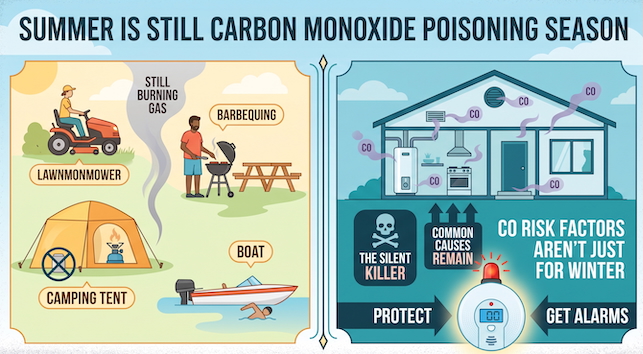 This summer has already made the point. Two adults died in Montgomery County, Maryland, from a vehicle running in a garage over the 4th of July weekend. Two children were dead beside a generator after a storm outage. Three other deaths were reported in southeast Michigan that weekend. Summit, new Jersey eight apartment units were evacuated. The one thing that public seems to understand about carbon monoxide they’ve got wrong, that is is a winter problem, is simply wrong.
The term winter flu, which was used in ER rooms around the world interchangeably for carbon monoxide poisoning makes it sound like it’s a winter problem. But the last few weeks have made it eminently clear that carbon monoxide marches on in the summer. This all happening in June and July. It’s not just furnaces that are full of fuel burning appliances, hot water heaters, ovens, cars. They all run in the summer. Combination boilers that heat both the room air and the domestic hot water. The water we use to do dishes, to take showers, to do our laundry. Those run in the summer just as much as they run in the winter. When we think about hotels and carbon monoxide.
Hotels are Risky Places for Summer Carbon Monoxide Poisoning
The heating season isn’t a major element of what causes carbon monoxide in hotels, as most rooms themselves are heated by electricity. The largest gas burning appliances and sometimes the only gas burning appliances in hotels and other large commercial buildings are the boilers that are used to heat the hot water that people use. While the demand for heat from these boilers is reduced in the summer, the demand for hot water is not, especially during busy periods, like holiday weekends.
The other major cause of carbon monoxide poisoning in hotels are pool heaters. Pool heaters are probably the single most dangerous installed fuel burning appliance. I include spa heaters in the same category. If you are reading about a death in a hotel, it is probably the pool heater. Pool heaters don’t get to take the summer off.
Weather not the Only Factor in Carbon Monoxide Poisoning
Weather certainly is a factor in carbon monoxide poisoning. Take pools, for example. How much a pool heater is going to run in the summer is probably less than it would be in the winter, assuming you’re talking about an outdoor pool. But indoor pools may in fact be fighting the air conditioning and run as much or more in the summer. But even in hot climates, pool water that might be kept to 90 degrees, or spa at 103 degrees still has a significant differential heat demand overnight. The difference between the air and the water temperature will make the boiler fire. So on a 60 degree night, there may be a 30 to 40 degree temperature difference between the set temperature for the pool water and the outside air temperature.
Ambient Carbon Monoxide Levels Should be Zero
What doesn’t change in the summer versus the winter is our tolerance for carbon monoxide and indoor air. That tolerance is zero.
I carry a carbon monoxide detector in my laptop bag. Not the hardware store model that chirps when the battery dies. What I carry with me is the $99 one with the digital readout that shows actual ambient air PPM levels. I’ve been carrying it since 2009, after my first hotel poisoning case.
Back then, almost no hotels had carbon monoxide alarms, even in their equipment rooms. In our first case, there was a carbon monoxide alarm in the equipment room, but the maintenance man had removed the batteries because it kept false alarming. Well he was wrong. That alarm was going off because the hotel was full of carbon monoxide.
My carbon monoxide alarm should always read zero, and when it doesn’t I take it serious, even in the summer. Carbon monoxide should never exist in indoor air. A normal indoor level is zero. Obviously, the rule doesn’t change depending on the month. It should read zero in December. It should read zero in July. If even 10 PPM there is something wrong.
I attended Undersea and Hyperbaric Medical Society’s national convention in Denver in May, and there was an excellent abstract presented to that with lead author of Gao: Demographic and Clinical Characteristics of Patients Undergoing Hyperbaric Oxygen Therapy for Carbon Monoxide Poisoning at an Academic Tertiary Care Center in the United States. This abstract had an elegant chart that demonstrated both the seasonal nature and the overall percentages of each major category of appliance to the total number of poisonings.
Based on that chart, clearly winter is the most serious time period for fixed indoor gas appliances. But overall, vehicle’s are the largest factor in carbon monoxide poisoning, and the vehicle based poisoning’s don’t seem to have any seasonal element.
In spring, gas powered tools jump to the top or near the top of the causes, with vehicles still a big part. During spring, Fixed appliances are shrinking, as a percentage, as the demand for heat lessons. Summer, the gas for heating indoor air risk factor falls away, but furnaces aren’t the only fuel burning appliance in many buildings.
Fall is a very serious time for problems with fixed appliances, because that’s the time of the year where those appliances are turned back on after a summer where they may have not been used at all, or they may have actually had maintenance done on or around them and their exhaust flues. December and January are the most serious months for carbon monoxide.
But the warm months is never zero. The takeaway is that the risk of carbon monoxide poisoning never drops to zero. And the events of the last few weeks is a stark reminder of that.
Leave a Reply
Want to join the discussion?Feel free to contribute!