NF-κB Is the Master Switch which Causes DNS
Carbon Monoxide Poisoning HBOT Shutting Off the NF-κB Inflammatory Firestorm. HBOT therapy can stop the inflammation and immunological over-response that causes brain damage, the syndrome called DNS.
By Attorney Gordon S. Johnson, Jr.
Most people think that carbon monoxide exposure is a simple binary choice. You go to the hospital, you get the carbon monoxide out of your blood, and you’re fine. You get oxygen therapy there. They put you on a rebreather mask. And when your COHb levels in your blood are down to 2 or 3%, which is considered close enough to normal, they send you home.
But the initial exposure does not mean surviving that first exposure. Getting your oxygen levels back doesn’t mean you’re going to be fine. In fact, what it means is that there’s still a 40% probability that if you were diagnosed with carbon monoxide poisoning because you had symptoms of carbon monoxide poisoning, you’re going to have long term neurological problems, which essentially come down to brain damage.
At that point in the emergency room, when the doctors are ready to be sending you home, if they are not discussing a referral with UHMS doctors in the hyperbaric department, they’re making a mistake. I’m not saying it’s a malpractice kind of mistake, but they’re making a mistake.
What they need to be doing is making a referral to hyperbaric oxygen therapy. And the reason they need to be making that referral, regardless of what the COHb levels might have been at the time, is that if there has been carbon monoxide poisoning, meaning you are symptomatic from the carbon monoxide poisoning, you’re at risk of an immunological attack that may not just go on for a few more hours. It may go on for days or weeks, and it may never shut down.
What is That Invisible Attack and What is DNS?
DNS is an abbreviation for a fancy term that is hard to say: Delayed neurological sequelae. Hard to spell too. It can start at the time of the poisoning, over the first hour or two while you’re still actually having your CO levels being brought down. Or it can actually start to materialize days and weeks later.
The term DNS is used in the literature because a long time ago, it was realized that CO patients were seemingly getting worse after they left the hospital. But DNS is just a CO-specific way of saying that your brain is under attack from an enemy that has a 40% hit rate. Brain damage happens to 40% of the survivors, regardless of whether or not they had a 5% or a 50% COHb level at the hospital.
What are the symptoms of DNS? It’s the same as what we see with brain damage. Memory gaps, brain fog, executive dysfunction, significant mood and personality disorders. The mood changes, which may occur contemporaneously with the changes in the cognitive profile, include depression, anxiety and PTSD-type symptoms.
Bottom line, DNS is not an abstract concept. It is the manifestation of a change in the way the brain is working. And it’s a change that is most likely caused by damaged brain cells.
NF-κB is the Master Switch
So let’s talk about the science of how the immune system runs amok, gets hijacked as an over-zealous bouncer of the body’s neurological system. There’s a master switch. That master switch creates intense cellular stress from the carbon monoxide toxin, and it puts the immune system on high alert. At the center of that battle is an inflammatory master switch named NF-κB, pronounced NF-Kappa-B.
I like to use the example of putting out a match under the sprinkler head in your office building or your hotel suite. The sprinkler system is supposed to protect you, just like that NF-κB is supposed to protect you. But the sprinkler system doesn’t necessarily stop because the match is out. And likewise, the NF-κB doesn’t stop just because the initial carbon monoxide has been removed from your blood. Like a sprinkler system that won’t turn off, the NF-κB ends up doing way more damage to your body than the original fire would.
NF-κB Starts a Microparticle Loop
Once that NF-κB gets stuck on, it releases this rigid, shell-like F-actin microparticles into your blood. And those are like bullets shooting through you. Those microparticles have a rigid shell and they travel back up to the brain, attacking the blood-brain barrier, ripping holes in it, and letting toxins flood the rest of your nervous system.
Hyperbaric Therapy is the Off Switch to Carbon Monoxide Poisoning
Why are we putting you through all this torture, of all these words that you’re going to have a hard time remembering? Well, the reason is that hyperbaric oxygen therapy is the off-switch to all of this.
The normal pressure oxygen patients receive in the ER, all it really does is push the carbon monoxide out of your blood. But pushing it off after it has started the sprinkler system of the immunological system isn’t enough. Normobaric oxygen does not do anything with respect to shutting off the inflammatory firestorm or stopping this attack of the microparticles.
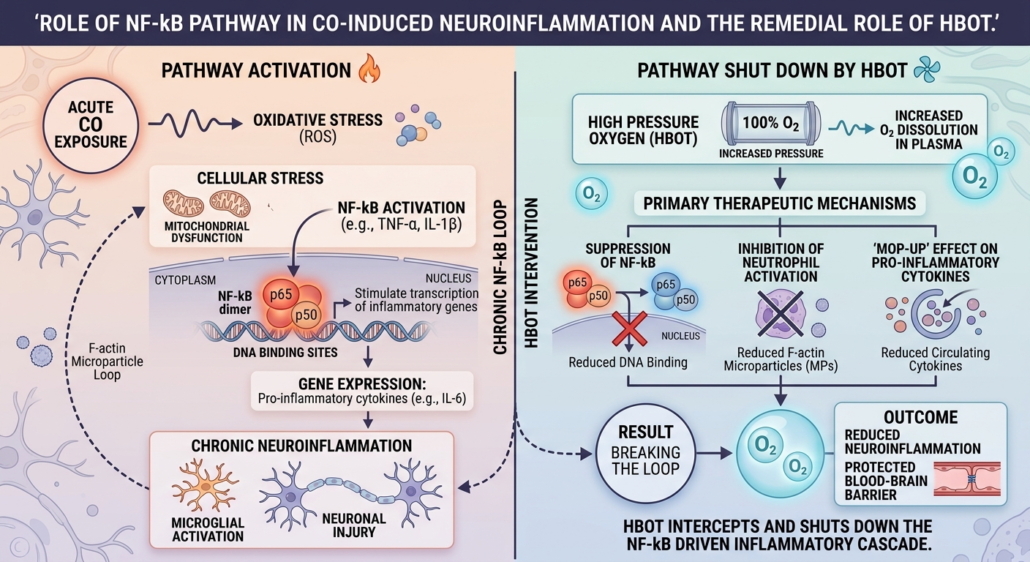
How carbon monoxide poisoning HBOT protocols turn off the master switch, stopping the chronic NF-κB loop and protecting the blood-brain barrier.
Hyperbaric oxygen therapy uses oxygen under high pressure to act as the off-switch. The oxygen under pressure forcibly deactivates the NF-κB. And HBOT halts the production of these inflammatory signals. Hyperbaric oxygen therapy alters the white blood cells, so they stop producing these culprits—these now-the-enemy microparticles. Hyperbaric oxygen therapy also floods damaged brain cells with the massive energy needed to patch up the blood-brain barrier.
The Clock vs. The Injury: Rethinking the 24-Hour Window
One of the frustrating things that came out of our attendance at the Undersea and Hyperbaric Medical Society (UHMS) annual scientific meeting in Denver last week was that there seems to be this concept that hyperbaric oxygen therapy is appropriate for treating people with carbon monoxide in the first 24 hours, but that if you’re treating them 24 hours to weeks later, you’ve missed the early window.
If you miss the early window, using hyperbaric oxygen therapy for treatment is considered an off-label use. It is off-label because it is only formally approved for the acute effects of CO poisoning. That is like saying that treating a severe brain injury survivor for increased ICP three days after the head injury isn’t acute. Until the DNS cycle is stopped, it remains an acute ramification of the poisoning. Treat until they get better.
It’s just hard to get your head around how the medical community can have such a clear awareness that hyperbaric oxygen therapy can stop the DNS cycle, but limit treatment to when it is defined as acute based on the clock, not based on the initial process of injury continuing. I will write a further blog about this position later.
Final Takeaway About Hyperbaric Therapy In CO
This NF-κB might be the specific thing that people can hang their hat on. To understand that we’ve got to stop the NF-κB from starting this cascading event. Baby steps. HBOT works because it stops the inflammatory immunological cycle. It works because it turns off the master switch, the NF-κB.
And for those of you checking my work, see https://journals.physiology.org/doi/abs/10.1152/japplphysiol.00097.2024
Trackbacks & Pingbacks
[…] is that regardless of the restored Oxygen levels, the brain is still in extreme danger. See our last blog for the NF-κB off switch. The toxic gas may be gone, but the molecular wildfire is off and running. Hyperbaric oxygen is […]
Leave a Reply
Want to join the discussion?Feel free to contribute!