
Safety Not Just for Elevators – Carbon Monoxide Preventive Maintenance
Carbon Monoxide Preventive Maintenance is as vital as elevator inspections and maintenance as 10 times more people are die or are hurt by CO.
By Attorney Gordon Johnson
The Carbon Monoxide Law Group has recently opened our office in Chicago on the 18th floor of a high rise in the South Loop. The other night, as I was heading to the elevator one of the elevators was closed and was blocked by a barricade. What was noteworthy to me was that the barricade had these words: “preventive maintenance in action for your convenience and safety.”
Preventive/preventative maintenance is something we are always preaching in carbon monoxide prevention, but there was something profound to me about making that connection to elevator safety. Elevator safety is ingrained into us. We see the inspection certificates in all the elevators we ride in. But as I thought about it, of course keeping elevators safe isn’t just about passing inspections, it is about doing preventive maintenance on them along the way.
And it seemed like the most natural thing in the world. Of course they are doing preventive maintenance on the elevator. I have a mental picture of a lifetime of elevators where I have seen safety inspection certificates. Who would want to ride on an elevator where they weren’t doing preventative maintenance? Think of the risks.
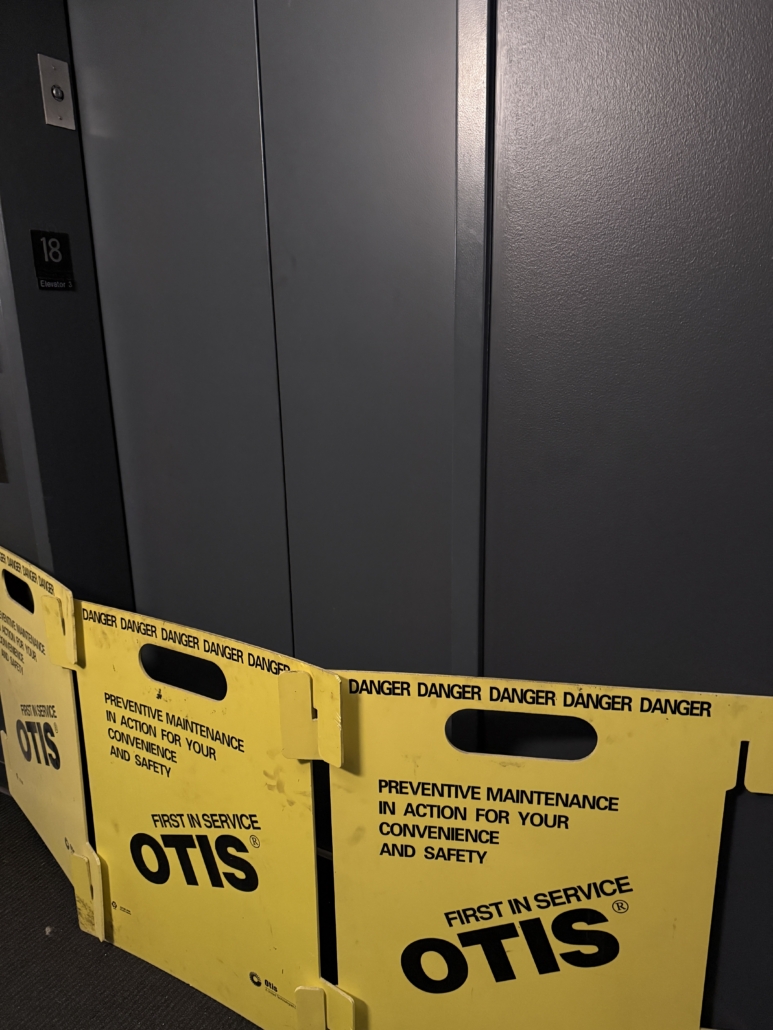
I was reminded of the need for carbon monoxide preventive maintenance by this barricade at an elevator that was under repair. Safety is not just for elevators.
As I thought about it, I compared this to the rampant neglect of preventive maintenance in the fuel burning appliances that have caused the numerous carbon monoxide poisonings that my clients have suffered. If elevator maintenance is the high end of the scale, apartment complexes and hotel pool heaters are at the bottom end of the scale. Why is it so natural for people to think in terms of preventive maintenance for an elevator but not for fuel burning appliances, the kind of machines that can create carbon monoxide poisoning.
As I pondered this, I was willing to bet that carbon monoxide involved more deaths and injuries than elevators. While the total exposure risk is certainly greater for CO [1]I was right about the totals. Total deaths from elevator and escalators annually in the US, 31[2] versus total deaths from carbon monoxide annually, 400[3]. Total injuries from elevators/escalators in the US annually, 15,000 versus total ER visits for CO, 100,000. However, the difference is even more dramatic than that, because 90% of the escalator and elevator accidents occur during construction. Thus, in terms of the average Americans day to day use of elevators, they are relatively safe.
Carbon Monoxide Preventive Maintenance is Key to Safety
Unfortunately, the same can’t be said about fuel burning appliances. The more I thought about this, the more I became convinced that the reason for the relative safety of elevators is the expectation of preventive maintenance. We demand it, if only implicitly with elevators. Property owners don’t see the need on something so seemingly simple as furnaces, hot water heaters and boilers. Underestimating the risk of fire is a huge mistake.
Fuel burning appliances are fires, which we think are under control, because they are under the hood, so to speak. If the only thing you maintain about an appliance that is premised on combustion is the way the heated air circulates within the living space, you are not adequately checking under the hood. Every year, the combustion and exhaust process must be checked. That is what preventive maintenance should be about. If you ever bothered to look at the Owner’s Manual for your appliance, it would be spelled out there.
Carbon Monoxide Survival is not All Clear
I had one other interesting analogy come to mind comparing elevator incidents to carbon monoxide events. What is the worst experience most people have had with an elevator? Usually it is getting stuck in there for a period of time. Bad few minutes or hours, but the doors open and then you are fine.
Unfortunately, that is not the true of carbon monoxide, even if that is how the ER may treat non-fatal poisonings. If 100,000 people went to the ER last year in the US, 90,000+ of them were sent home with a clean bill of health. But surviving a CO poisoning is not like having the doors opened after a period of uncomfortable entrapment. 40% of those people who went to the ER and probably and equal number who didn’t, will have permanent brain damage from CO.
Preventive maintenance is the key to safety, not just carbon monoxide safety, not just elevator safety, for all safety. Until we start doing preventive maintenance as the manual requires, the assumed safety we have when we get on an elevator is not going to be true with the air that we breathe.
While you may not fall from heights from carbon monoxide, when you fall, you may never get up again. Even if you survive the poisoning, you are at serious risk of a permanent change in the way you think, you feel, you interact with others.
[1] Almost every building has some sort of an HVAC system and most of those north of the Gulf Coast are likely to have some fuel burning appliance. In contrast: Here are the key data points that define this usage, according to Googles AI:
- Total Elevators: There are approximately 900,000 to over 1 million elevators operating in the United States.
- Daily Usage: Americans make over 18 billion to 20.6 billion passenger trips per year. This means that on average, elevators carry the equivalent of the Earth’s population every 3 days.
- Daily Rides per User: The average user takes 4 trips in an elevator daily.
- Workforce/Urban Density: Around 83.3% of the U.S. population resides in urban areas, where high-rise office buildings, hotels, and residential, mixed-use buildings requiring elevators are common.
[2] Source: Deaths and Injuries Involving Elevators or Escalators, Michael McCann, PhD, CI September 2013https://www.cpwr.com/wp-content/uploads/elevator_escalator_BLSapproved_1.pdf
[3] Source CDC: https://www.cdc.gov/carbon-monoxide/about/index.html#:~:text=Each%20year%2C%20more%20than%20400,more%20than%2014%2C000%20are%20hospitalized
Leave a Reply
Want to join the discussion?Feel free to contribute!